Loading
Loading

Polar Bear

( Ursus maritimus )

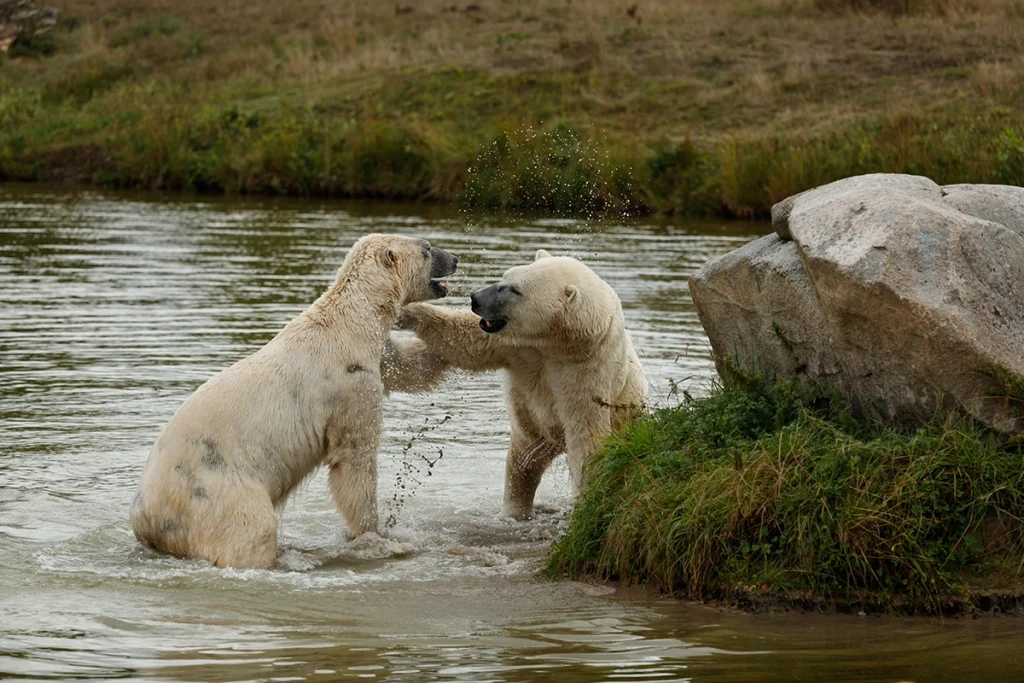
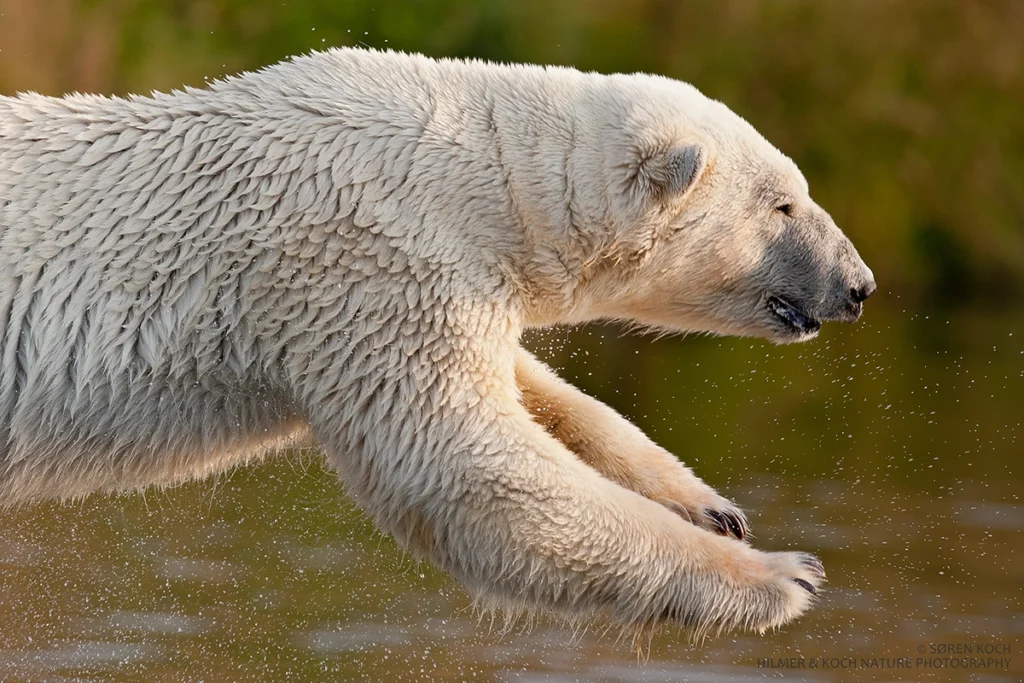
The polar bear is the world’s largest landliving predator. A large male can easily weigh over 500 kg and reach 3 meters in height when standing on its hind legs. Females are about half the size of males. Polar bears almost exclusively eat seals, which they hunt from the sea ice. As temperatures rise, the sea ice disappears, and the ice-free period during summer is getting longer and longer. This makes polar bears highly affected by climate change

Get to know Polar Bear

Classification: Mammals

Order: Carnivora

Family: Bears (Ursidae). There are 8 species of bears in the world.

Distribution: Arctic Circle

Habitat: Tundra, ice and water

Lifespan: In the wild 15-25 years. In captivity up to 40 years.

Sexual maturity: Male: 6-10 years; Female: 4-6 years

Oestrus: March to May

Gestation: 7-9 months (extended gestation)

Number of offspring: 1-3, usually 2 every 2-3 years

Diet: Carnivorous; mainly seals.

Habitat

The polar bear lives far to the north, within the Arctic Circle, and is closely tied to sea ice. Although it is known as the world’s largest land-based predator, it spends most of its life at sea, using the ice as a platform for hunting seals. Polar bears prefer areas with so-called seasonal ice – sea ice that melts in the summer and freezes again in winter – as these regions often have the richest food sources.

When seawater freezes, the salt is pushed out, forming tiny channels within the ice. Microscopic algae grow in these channels, forming the base of the entire Arctic food web. That’s why this type of sea ice is also where the largest numbers of seals are found, which is the polar bear’s most important prey.

In summer, when the ice melts, many polar bears are forced inland to the tundra. Here, they often fast for long periods while waiting for the ice to return. Pregnant females seek out coastal areas in late summer with deep snow or large piles of seaweed, where they dig dens to give birth and care for their cubs throughout the winter.
Because the polar bear is so dependent on sea ice, it is especially vulnerable to climate change. As temperatures rise, the ice melts earlier and more extensively, leaving polar bears with fewer hunting grounds and reduced access to food.

Distribution

The polar bear is distributed throughout the Arctic region, where it lives along coastlines and on sea ice in five countries: Canada, Greenland, Norway (Svalbard), Russia, and the USA (Alaska). Within this range, polar bears are divided into 19 recognized populations that are geographically separated but often have overlapping habitats. The largest populations are found in the Canadian Arctic, around Svalbard, and in northern Alaska and Russia.

These populations are continuously monitored by international research groups, and their status varies from region to region. Some populations are considered stable, while others are believed to be in decline due to climate change.

The polar bear is classified as “Vulnerable” (VU) on the IUCN Red List, which means the species is at risk of becoming endangered if current trends continue.

Distribution

The polar bear is distributed throughout the Arctic region, where it lives along coastlines and on sea ice in five countries: Canada, Greenland, Norway (Svalbard), Russia, and the USA (Alaska). Within this range, polar bears are divided into 19 recognized populations that are geographically separated but often have overlapping habitats. The largest populations are found in the Canadian Arctic, around Svalbard, and in northern Alaska and Russia.

These populations are continuously monitored by international research groups, and their status varies from region to region. Some populations are considered stable, while others are believed to be in decline due to climate change.

The polar bear is classified as “Vulnerable” (VU) on the IUCN Red List, which means the species is at risk of becoming endangered if current trends continue.

The Polar Bear park

The polar bear facility at Scandinavian Wildlife Park was built in 2005 and opened in 2006. It is among the largest and most highly regarded enclosures of its kind in the world. Covering a total of 26,000 m², the enclosure is designed to mimic the polar bear’s natural summer habitat – when the sea ice has melted.

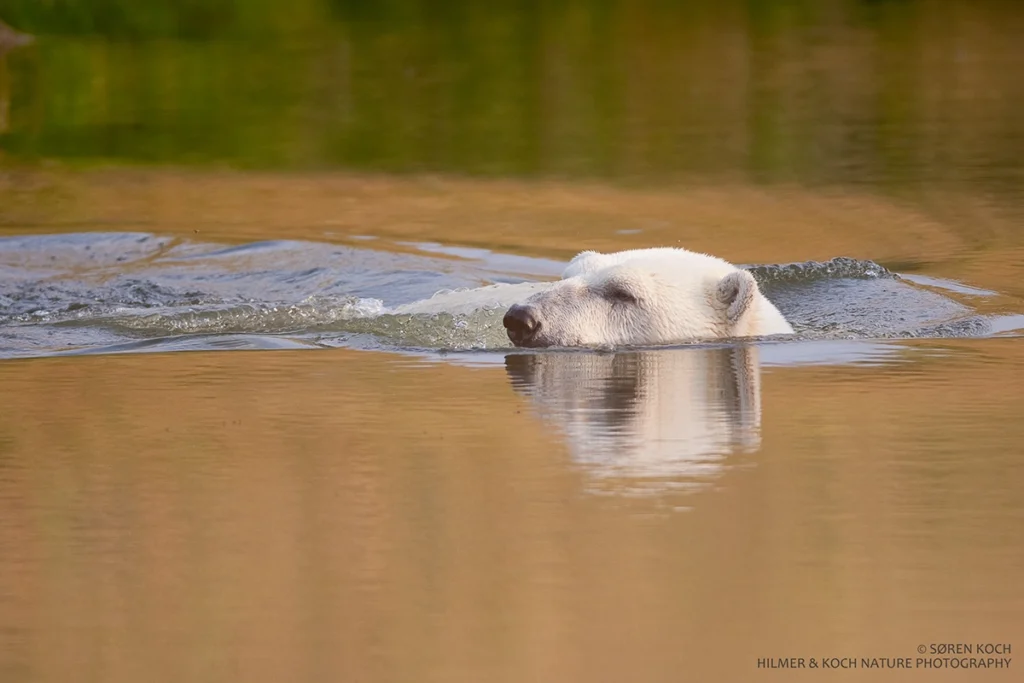
The Polar Bear Park is divided into four smaller sections: two viewing enclosures and two off-exhibit areas. All enclosures feature large lakes, with the biggest located in the main viewing area. This central lake spans 5,000 m² and is up to five meters deep, offering the bears plenty of space to swim and play. In addition, each enclosure includes hills, large rocks, and tree trunks, allowing the bears to move around naturally and stay physically active.

Visitors can get up close to the polar bears via a 220-meter-long boardwalk that winds through the main viewing area. From here, guests can observe the bears at eye level and even watch them swim directly beneath the walkway. Experts highlight this enclosure as one of the best in the world for polar bears, precisely because it considers their natural behaviors and needs.

The residents

At Scandinavian Wildlife Park, you’ll find one of the largest groups of polar bears in captivity in the world. There are a total of 8 polar bears living in the Polar Bear Park – 4 males and 4 females.

In our large polar bear facility, we have the ability to divide the 8 polar bears into different groups, and right now they are spread out across 3 of the 4 enclosures.

In one of the enclosures, you’ll find our 4 massive males, who together weigh approximately 2 tons. These are usually the ones seen during the daily feedings. The second group consists of 3 of our females – Nuno and her two large cubs – and they live in another enclosure where guests can get very close. Our last female polar bear lives in the winter enclosure, which is not visible to our guests.

Name:

Nanok

Born:

05.12.2001

Nanok was the first polar bear to move into Scandinavian Wildlife Park back in 2005. He is the father of Siku and Nuno and is currently paired with Friida. 

Name:

Siku

Born:

22.11.2011

Siku was born at Scandinavian Wildlife Park and was hand-raised by the park’s animal care staff, as his mother was unable to produce milk. 

Name:

Ivan

Born:

12.11.2005

Ivan moved into Scandinavian Wildlife Park in 2017. He is paired with Nuno and is the father of Nivi and Anori. 

Name:

Vicks

Born:

06.12.2010

Vicks moved into Scandinavian Wildlife Park in 2021. 

Name:

Nuno

Born:

21.11.2012

Nuno was born at Scandinavian Wildlife Park. She has a twin brother named Nanu, who has since moved to France. Nuno is the mother of Nivi and Anori.

Name:

Nivi

Born:

12.12.2021

Nivi was born at Scandinavian Wildlife Park and is the twin sister of Anori. 

Name:

Anori

Born:

12.12.2021

Anori was born at Scandinavian Wildlife Park and is the twin sister of Nivi. 

Name:

Friida

Born:

16.12.2002

Friida moved into Scandinavian Wildlife Park in 2025. She is paired with Nanok and is genetically the most important female polar bear in the European breeding program. 

Verdenskort